

Hearing loss and tinnitus—or ringing in the ears—are two of the most common disabilities related to military service. In fact, most military service includes some exposure to acoustic trauma, from working on aircrafts to testing and firing weapons. Even when hearing loss and tinnitus are not reported in a veteran’s service records or upon discharge, these conditions may still be related to service.
Once the VA has agreed that your current hearing loss and/or tinnitus are related to service, the VA will assess the severity of your condition and assign a rating code. This rating will correspond to monthly compensation; thus, it is important for the VA to adequately assess the severity of your hearing impairment.
The Tinnitus Rating
For tinnitus, the regulations provide that you may only receive a 10% rating. This rating is not impacted by the severity of your tinnitus or whether it occurs in one or both ears. The VA will only give a 10% rating for tinnitus, regardless.
The only exception to this is if your tinnitus causes a secondary condition. For example, if your tinnitus is so severe that it causes migraines, then you may file a claim for a separate rating for migraines.
As of December 1, 2025, a 10% rating for tinnitus is $180.42 per month.
To learn more about tinnitus claims, click here.
The Hearing Impairment Rating
 In order for the VA to assess the severity of your hearing impairment, the VA must afford you an adequate medical opinion.
In order for the medical opinion to be adequate, the examination must:
- Be conducted by a state-licensed audiologist,
- Include a controlled speech discrimination test (Maryland CNC) and a puretone audiometry test, and
- Be conducted without the use of hearing aids.
For more information on adequate audiological evaluations, click here.
The VA will then assess the severity of your hearing loss based on the speech discrimination test and puretone audiometry test, using the following steps.
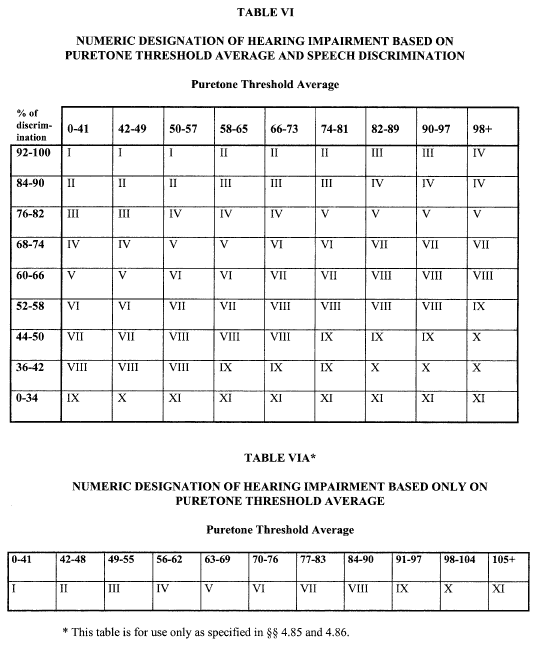
- Find the puretone threshold average, which is thesum (or total) of your puretone thresholds at 1000, 2000, 3000 and 4000 Hertz, divided by four. This average is used to determine the Roman numeral designation for hearing impairment from Table VI or VIa (below).
- Find the Roman numeral designation for each ear using Table VI or Table VIa below.Use Table VI, “Numeric Designation of Hearing Impairment Based on Puretone Threshold Average and Speech Discrimination,” to determine a Roman numeral designation (I through XI) for hearing impairment based on a combination of the percent of speech discrimination (horizontal rows) and the puretone threshold average (vertical columns). The Roman numeral designation is located at the point where the percentage of speech discrimination and puretone threshold average intersect.
If the audiologist finds that a speech discrimination test is not appropriate (due to language difficulties, inconsistent scores, etc.), then you can use Table VIa, “Numeric Designation of Hearing Impairment Based Only on Puretone Threshold Average,” to determine a Roman numeral designation (I through XI) for hearing impairment based only on the puretone threshold average.
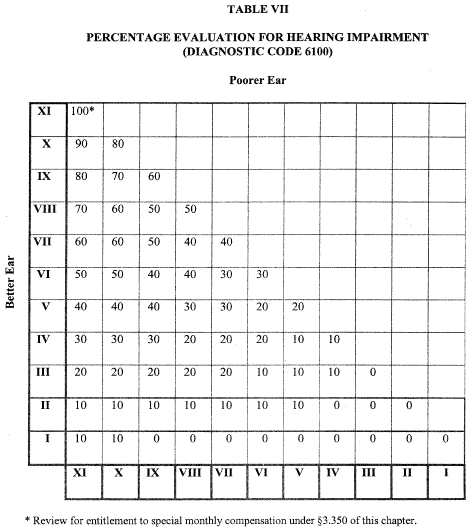
- Combine the Roman numeral designation for the left ear and the Roman numeral designation for the right ear to determine the appropriate rating under Table VII, “Percentage Evaluations for Hearing Impairment.” The horizontal rows represent the ear having the better hearing and the vertical columns the ear having the poorer hearing. The percentage evaluation is located at the point where the row and column intersect.If hearing impairment is only service-connected in one ear, the non-service-connected ear will be assigned a Roman numeral designation for hearing impairment of I.
- Finally, you should consider whether the hearing impairment warrants special monthly compensation due either to deafness, or to deafness in combination with other specified disabilities.
Appealing a VA Rating for Hearing Loss
If you have received a VA rating for your hearing loss that you feel is inadequate, you may want to appeal. In deciding whether to appeal, you should review the VA medical examination on which the VA relied, and consult with the charts above to see if the VA made a mistake. If you cannot locate a mistake by the examiner or the rater using the charts, then you may want to request a new medical examination based on worsening symptoms or consider filing a claim for special monthly compensation or secondary conditions.
VA healthcare also offers a variety of audiology services for which you may be eligible. You can learn more about these on the VA’s website.
Contact us to appeal your VA disability claim denials now!
Has the VA denied your claim for service-connected tinnitus or hearing loss, or underrated your conditions? We are here to help you appeal! Contact us to reach our advocates today, or call 1 (877) 777-4021 to take the next step in obtaining the VA disability benefits you deserve.